Before coming to Morocco, I had three places in mind to visit: Marrakesh, Tangier, and the Sahara (if we could somehow swing it).
With the holidays and Sevilla sightseeing, I hadn’t given our next country much thought. I knew we’d be arriving via ferry in Tangier and the boys would be attending a month-long Worldschool Hub in a surfing town Lori and I had never heard of.
Our Euro-African Journey (So Far...)
I figured, hey, we had 90 days in Morocco. We’d figure it out.
Part of this I attribute to the travel fatigue we both were starting to feel after a month in Spain. Sevilla was always busy, the weather was cold and often rainy, and we had to pre-plan and pre-book nearly everything we saw and did.
But our arrival in Tangier changed all that. It breathed new life into our travels and I felt like that I got a second wind.
We finally got to explore a new country in a new part of the world that actually felt different. After five years of speaking Spanish (and a bit of Portuguese in Portugal), this was a big deal. It felt like travel again, our kind of travel.
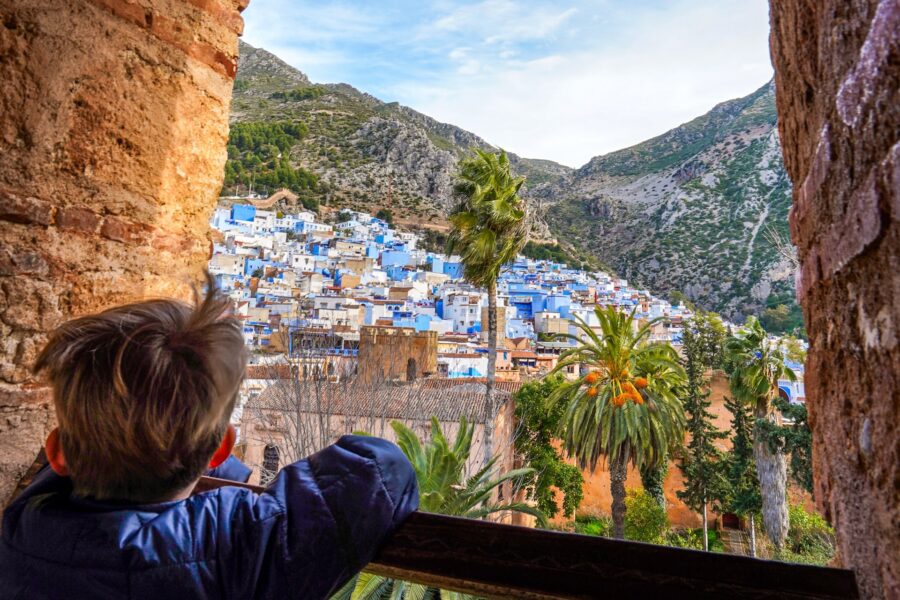
I devoured information on Tangier and further afield into Morocco. The Blue City of Chefchaouen—though not the easiest place to reach—quickly went on our itinerary.
Diving deeper, it started to sound like spending time in Fez was actually what we after, not necessarily Marrakesh. Not so long ago, Marrakesh was where intrepid travelers went to immerse themselves in the exotic and romantic aspects of Moroccan culture, get lost in ancient labyrinthine alleyways, haggle with traders, and so on.
Most recent travel accounts seemed to debunk this idea, making Marrakesh sound like a hellish Disney-fied version of its former self. For an authentic, immersive experience along the lines of what most visitors think of when they think of Marrakesh, travelers and writers seemed to agree that Fez was the way to go.
So, we added two weeks in Fez to our itinerary, opting to place ourselves in the heart of the Medina. For good measure, we sprung for a more memorable stay than the usual economy flats we tend to pick these days.
It was a very good call.
Fez wasn’t an easy or always comfortable stay. But it provided one of the most worthwhile and memorable travel experiences we’ve had in a long time. We learned much about Moroccan culture and the kids seemed to really enjoy it and get a lot out of our stay as well—despite it raining most days.

Leaving the Blue City on a bus bound for Fez.
You can travel from Tangier to Fez by rail, but you can’t travel from Tangier to Chefchaouen, or Chefchaouen to Fez by rail. So this leg was another bus leg. Hopefully, we’ll be able to take advantage of Morocco’s train network at some point in our travels.
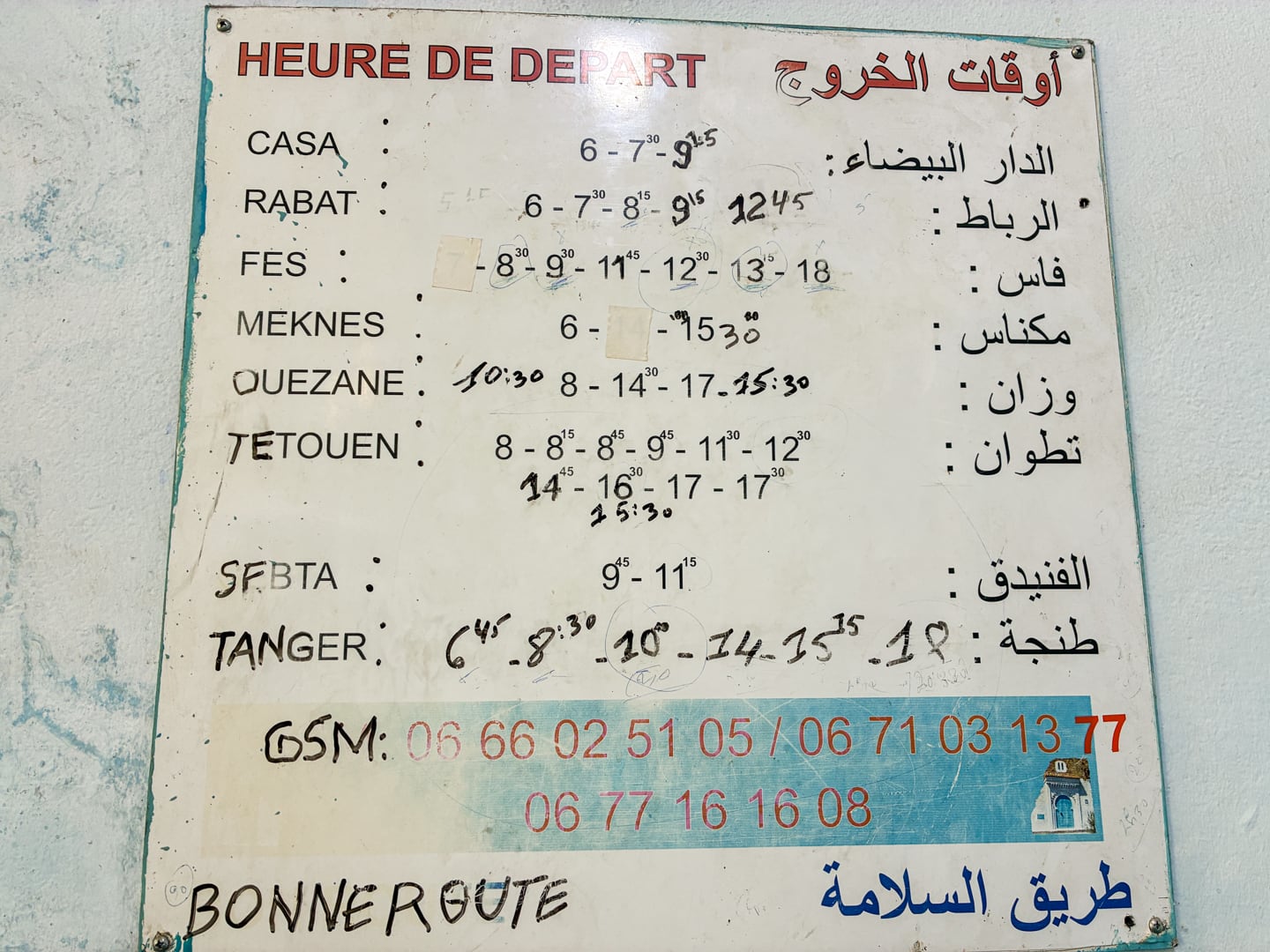
That’s the bus schedule from Chefchaouen, if you’re curious.
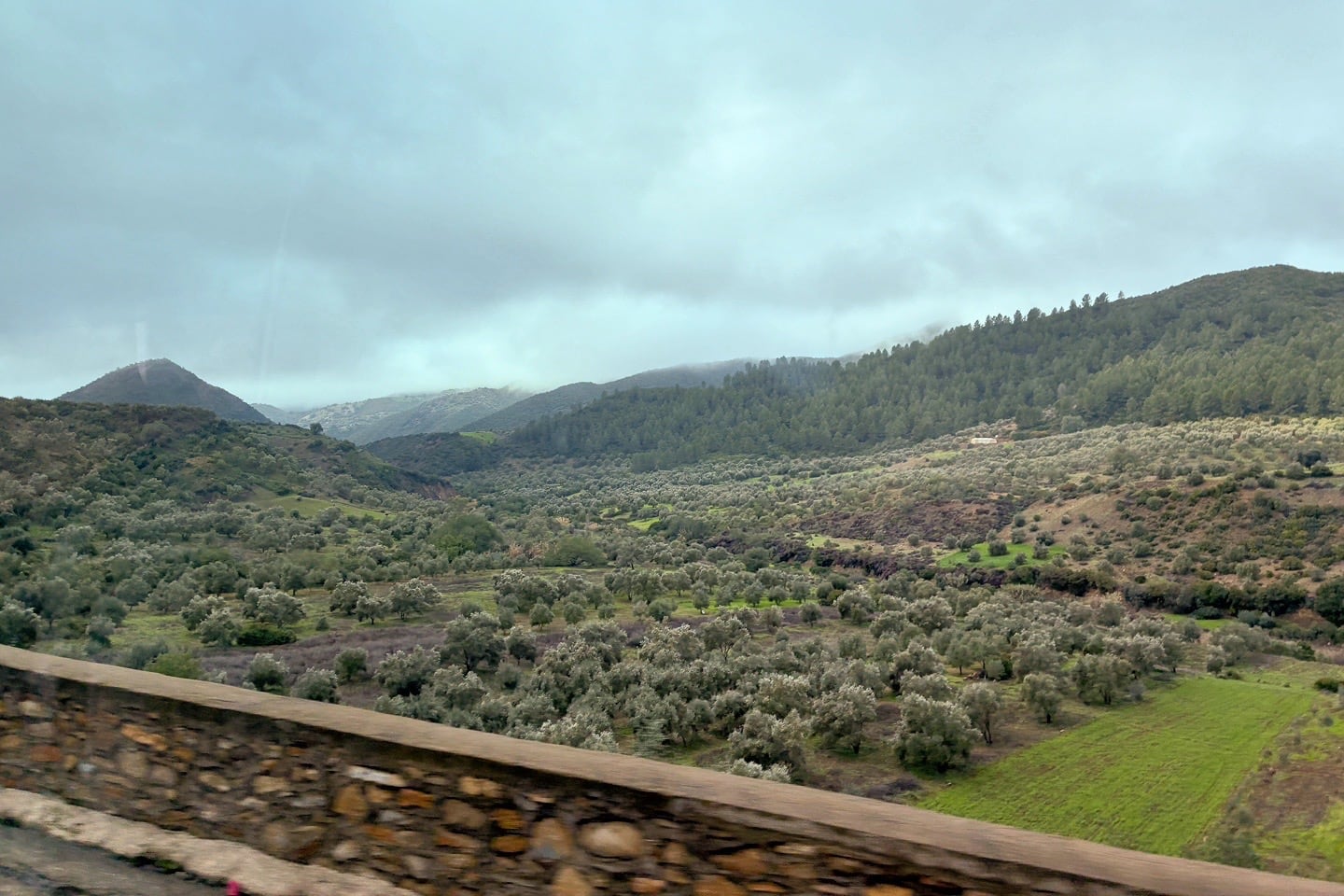
Lots of green in this part of the country (and time of year).
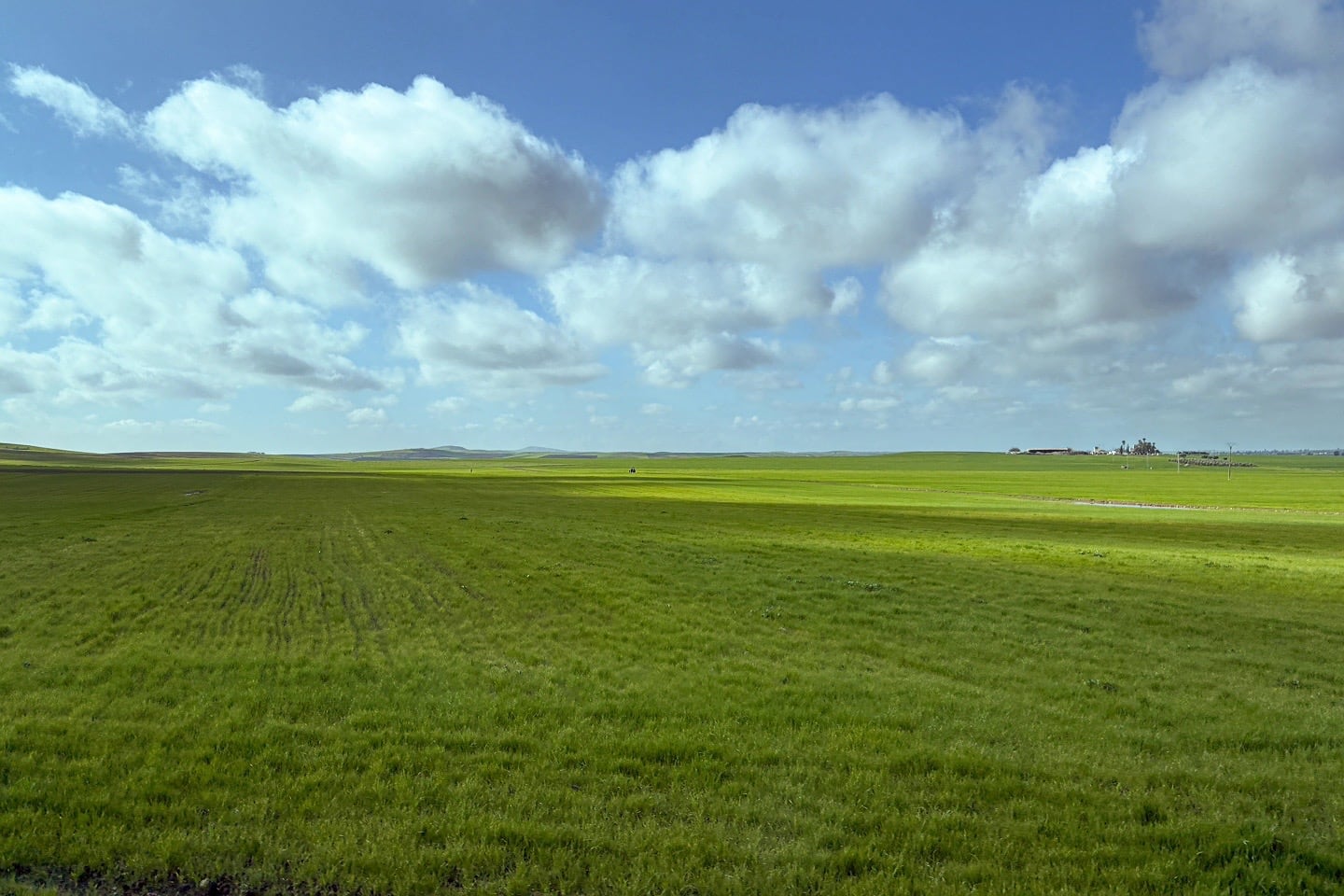
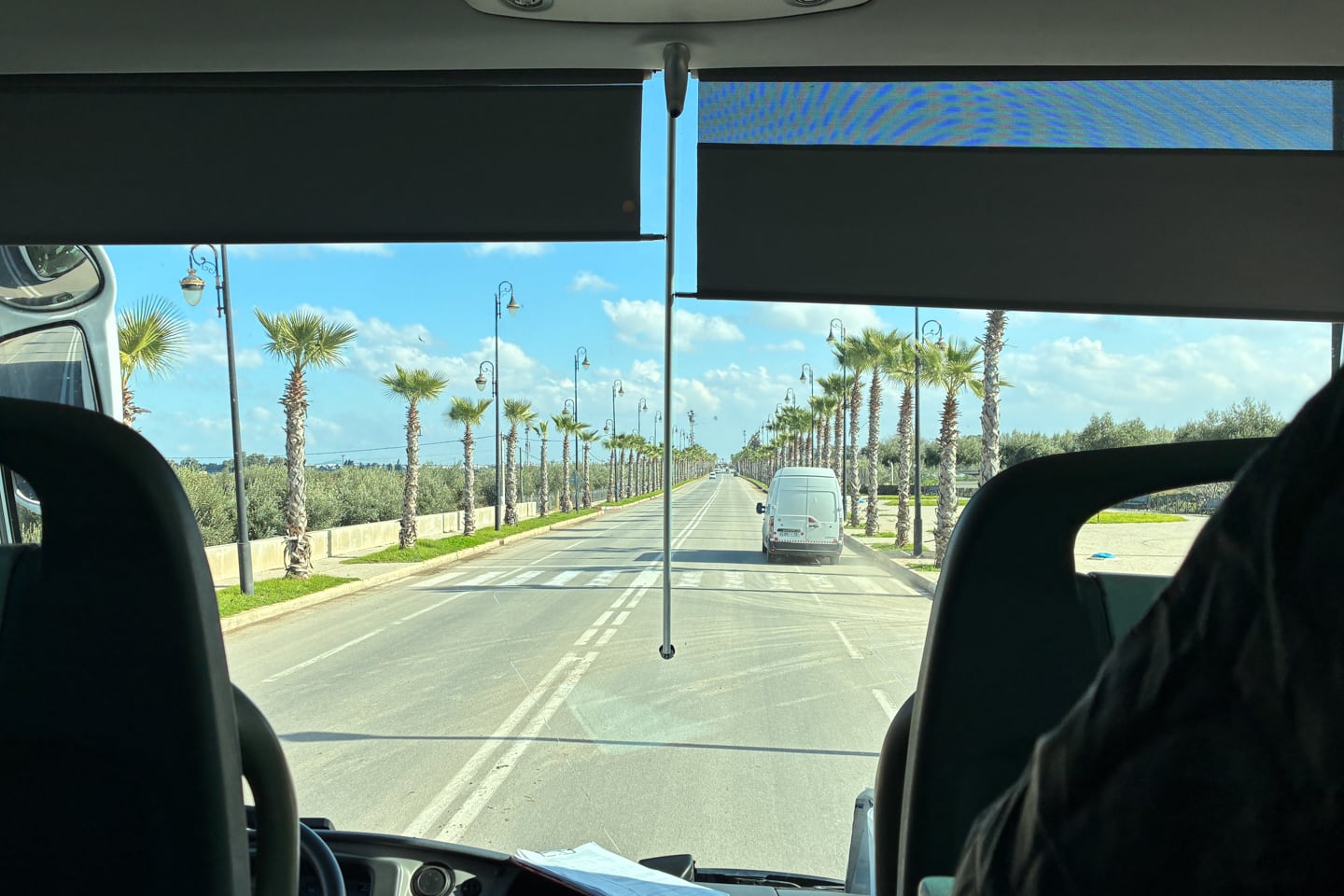
The highway coming into Fez is lined with palms.

And thar she blows! The largest urban pedestrian-only space in the world (no cars!)—and one of the oldest—the Fez Medina. We got our first glimpse from the front of the taxi coming from the bus station. It looks like a crazy jumble of buildings and humanity, and in many ways it is.
Founded in the 9th century, the Medina of Fez (Fes el-Bali) is massive. 9,000 alleyways and an estimated 100,000 to 150,000 people crammed into less than one square mile. It’s the largest Medina in the world and a UNESCO World Heritage Site.

As there are no motorized vehicles permitted in the Medina (only donkeys and small garbage-hauling tractors), the taxi could only get us so close to our accommodations. From the nearest road, it’s a 10 minute walk with all our stuff (uphill).
Luckily, our host came to meet us to guide us to our place. Even with a smartphone, specific places in the Medina are very hard to find, as map apps aren’t always accurate, and GPS is spotty inside.
After weaving and winding our way through medieval passageways and up numerous stairs, we arrived at a nondescript door in a narrow and dark tunnel. Our host opened the door, and up more stairs we went to reach the main floor of the 400-year-old Riad we’d call home for the next 14 nights.

This stay was up there with the most fascinating and memorable stays we’ve ever had. We felt incredibly fortunate to have had the opportunity to stay in such a historic home and have it all to ourselves (most Riads in Fez are shared accommodation).
Here’s our full post on this historic Fez Riad.

The Fez Medina is a place that’s easy to love one minute and loathe the next.
It’s an intrepid traveler’s dream, but one that demands a lot out of you (provided you leave the confines of your accommodation on a regular basis—we tried to every chance we got when the weather cooperated).
The spine of the Medina, which roughly runs from east to west, was frequently packed with tourists (mostly Moroccans during our stay, as it was a school holiday). If we could get ourselves out and about before 10am, it was very quiet.
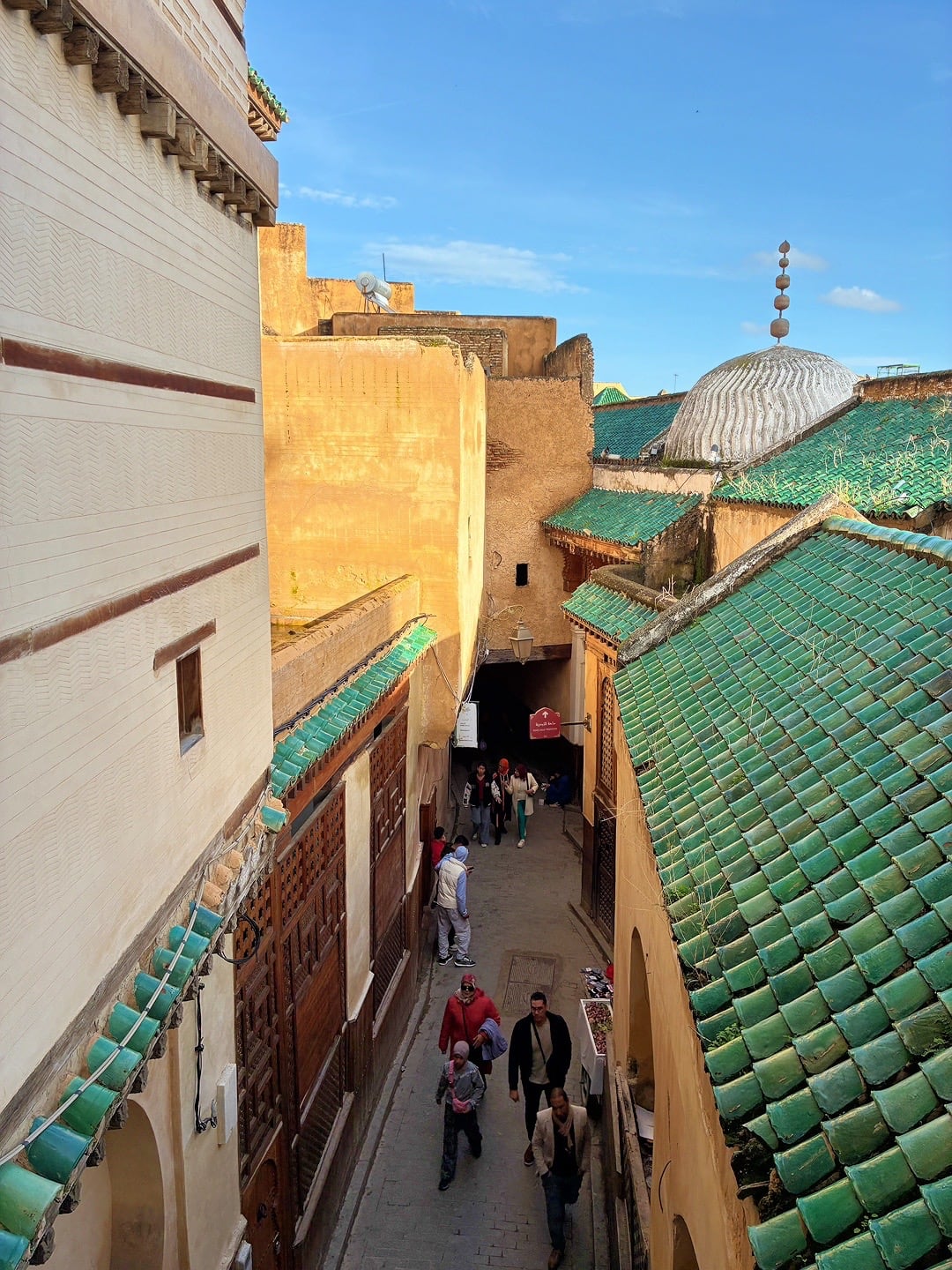
However, straying off the main drag just a little bit often meant losing most of the crowds. With 9,000 alleys to choose from, that’s not too hard.

Most days, we prepared our own meals back at the Riad. There’s a Carrefour supermarket up in New Town that we stocked up at twice. For fresh produce, local bread (khobz), and daily odds and ends, however, Lori quickly found her favorite ma and pa stalls footsteps from our place.
Admittedly, we didn’t eat a lot of traditional Moroccan food in Fez. We ate out quite a bit in Tangier and Chefchaouen and knew we’d be limited to mostly local food in our next month in Mirleft.
With that said, we did manage to eat out a handful of times over two weeks. One of our favorite spots was Cinema Cafe. The spanakopita and falafel platter are awesome.

While we were there, the cafe received their shipment of Coke (and recycling collection, all in one).


Rain was a regular part of our stay. It didn’t seem to deter people, and we tried not to let it deter us, which meant a lot of wet clothes hanging about the Riad all the time.


One thing that surprised us about the Medina is how many of the alleyways are tunnels (covered passageways). Having no where else to expand to, it seems over time a great many of the alleys have been covered by additions to people’s homes. Our kitchen, in fact, was built over the street.

This was our first taste of msemens—flat savory pancake-like bread often filled with meat or vegetables. These were probably the least traditional ones we’ve seen, but they were delicious, nonetheless.

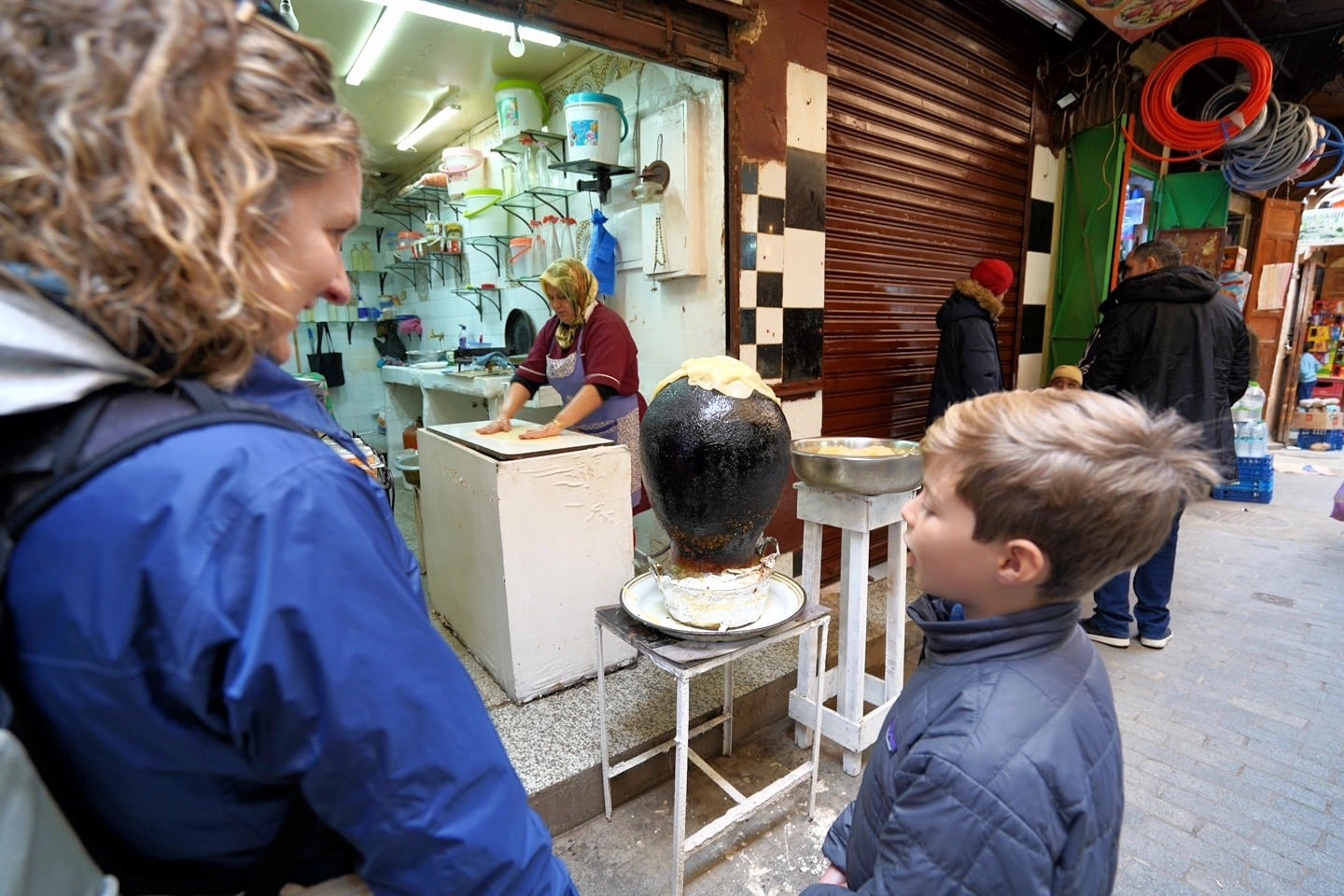
Sure, there were touristy areas of the Medina. But it was refreshing to see that most souks (traditional markets), particularly the fresh markets, seemed geared to (and patronized by) the locals.
Again, over 100,000 people live in this place, and its places like these where most of them get their daily provisions.

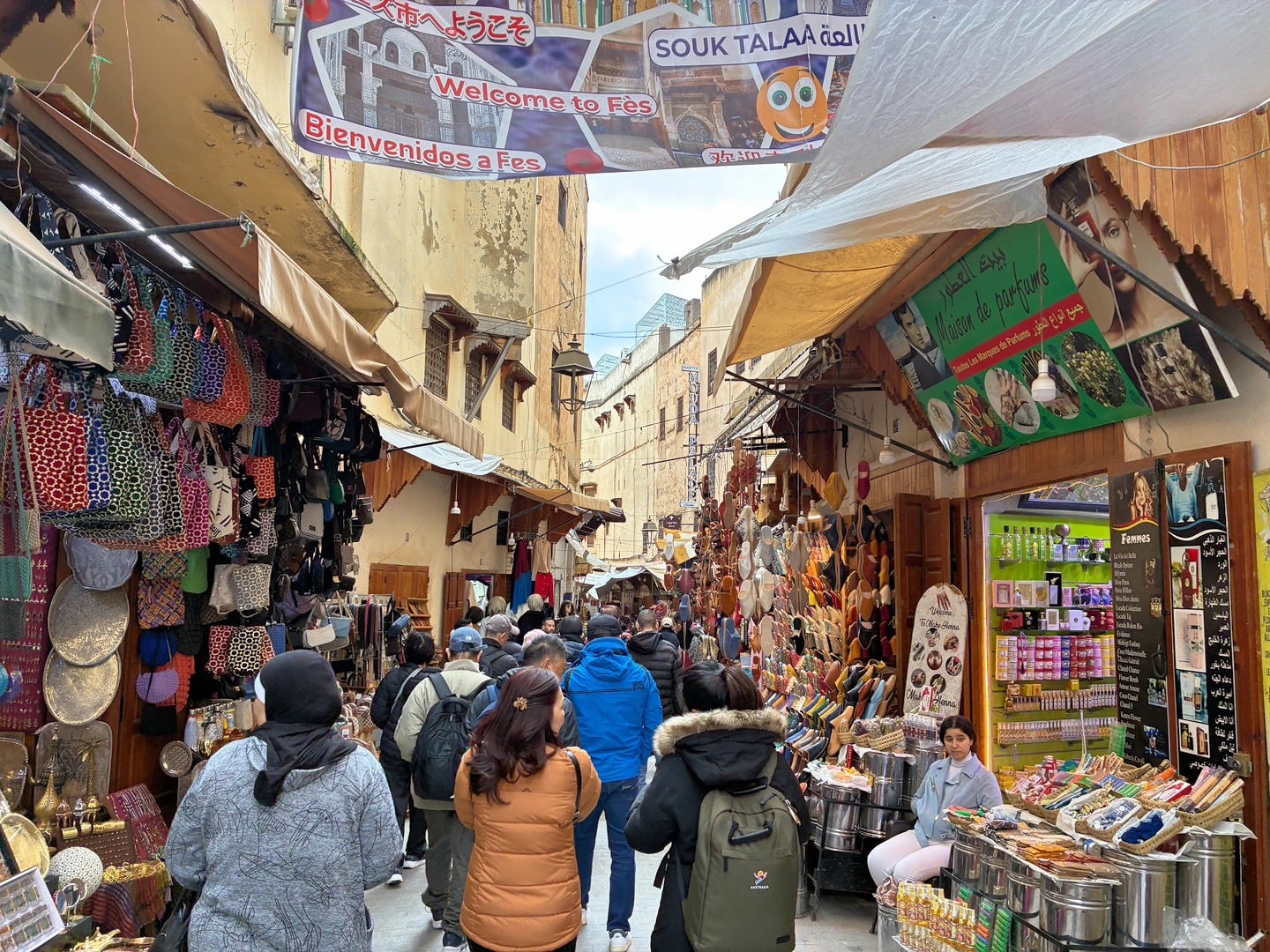
No matter where we ventured in the Medina, it seemed the tourist road of Talaa Kabira was never far away, and almost unavoidable.
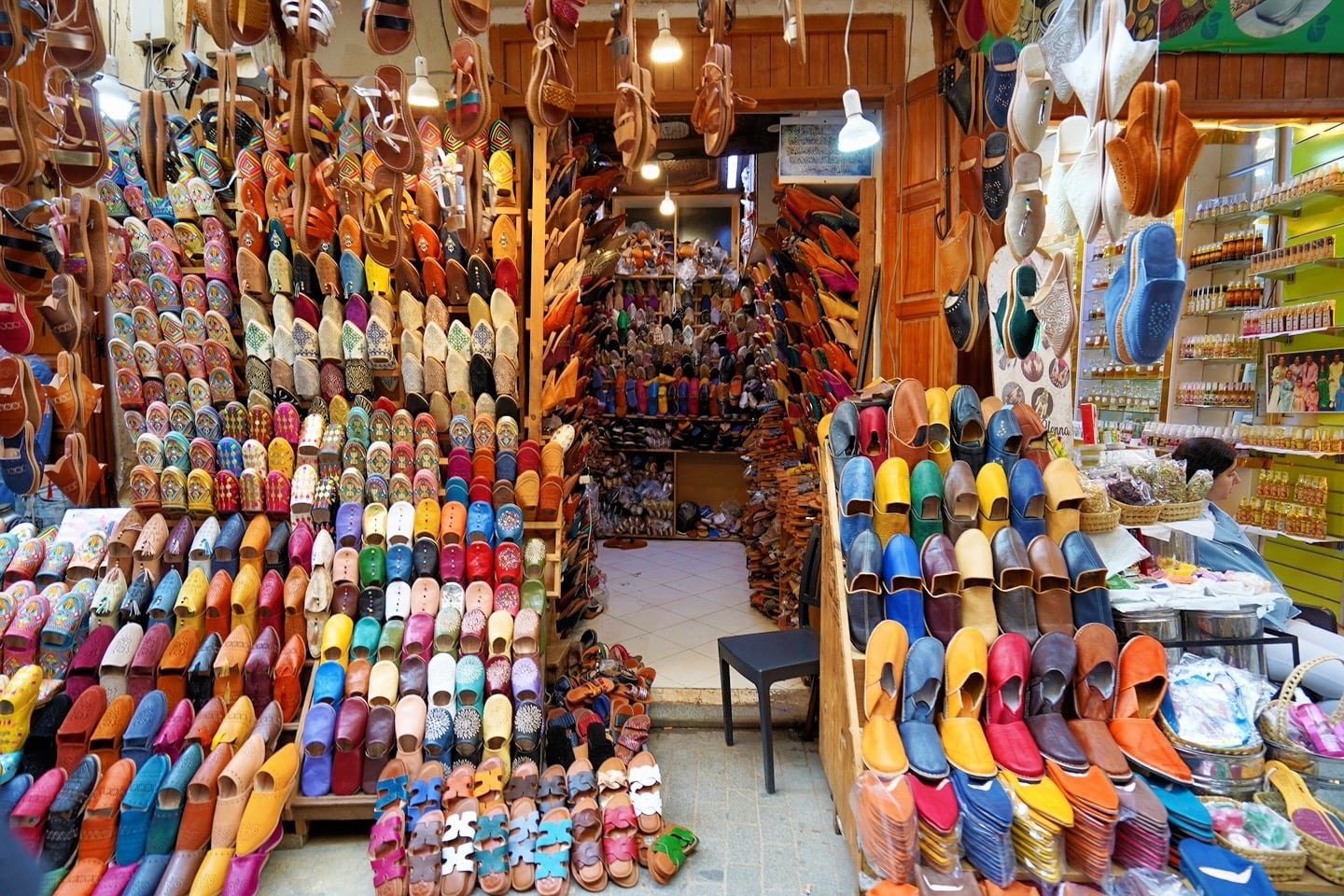
Traditional tanning and leather making in Fez continues to this day. Later, we would make a couple of visits to the heart of tanning in the Medina, Chouara Tannery.

Around our two week anniversary of arriving in Morocco, I stumbled upon a French rooftop terrace that was purported to serve—among other things—wine.
The last time we had had alcohol was our last night in Spain on Lori’s birthday. We were beginning to think we’d go the entire three months in Morocco without imbibing, and here was this place in the center of the Medina with French wine.
The sun was shining and it was a gorgeous afternoon, so we thought we’d go check it out.

The terrace turned out to be the rooftop of a swanky Riad (much larger and swankier than the one we were staying in, complete with a pool inside the lobby.

From the rooftop, you could still see about only half of the Medina. But the mountains were out and we got the best sunset in Fez yet. The wine wasn’t bad either.

The days in the Medina rolled by, and with it, more explorations.

And quick stops for a cafe nous-nous.


In recent years, there have been several high-profile stories of building collapses. The Medina is very old and many of the buildings have not been maintained properly. Efforts to secure and salvage the historic homes can be seen across town.

The Fez Medina really is a fun and fascinating place to explore, particularly when it’s not raining, the main roads aren’t packed with tourists, and young local guys aren’t trying to tell us “Road Closed! Road Closed!” in an effort to dupe us into enlisting their guided services.

The boys especially liked the area around Souk al Saffarin, where all the coppersmiths hang out, pounding metal.

All sorts of artisans and craftsmen carry on centuries-old traditions, many of whom helped restore the Riad we’re staying in.


Just outside the Medina walls, the boys found yet another group of kids to play soccer (football) with, under the watchful eye of the Medina cemetery.

Several days would often pass until we’d leave the Medina walls. Each time we did, it felt like driving into the wide-open spaces of Wyoming. Big sky everywhere, and lots of room to stretch out. It’s a hard feeling to convey if you haven’t spent nearly a week straight in the Fez Medina.

On this particular day, we took the opportunity to poke around Fes El-Jdid (the historic Jewish Quarter).


Just beyond El-Jdid is the Royal Palace (Dar al-Makhzen).
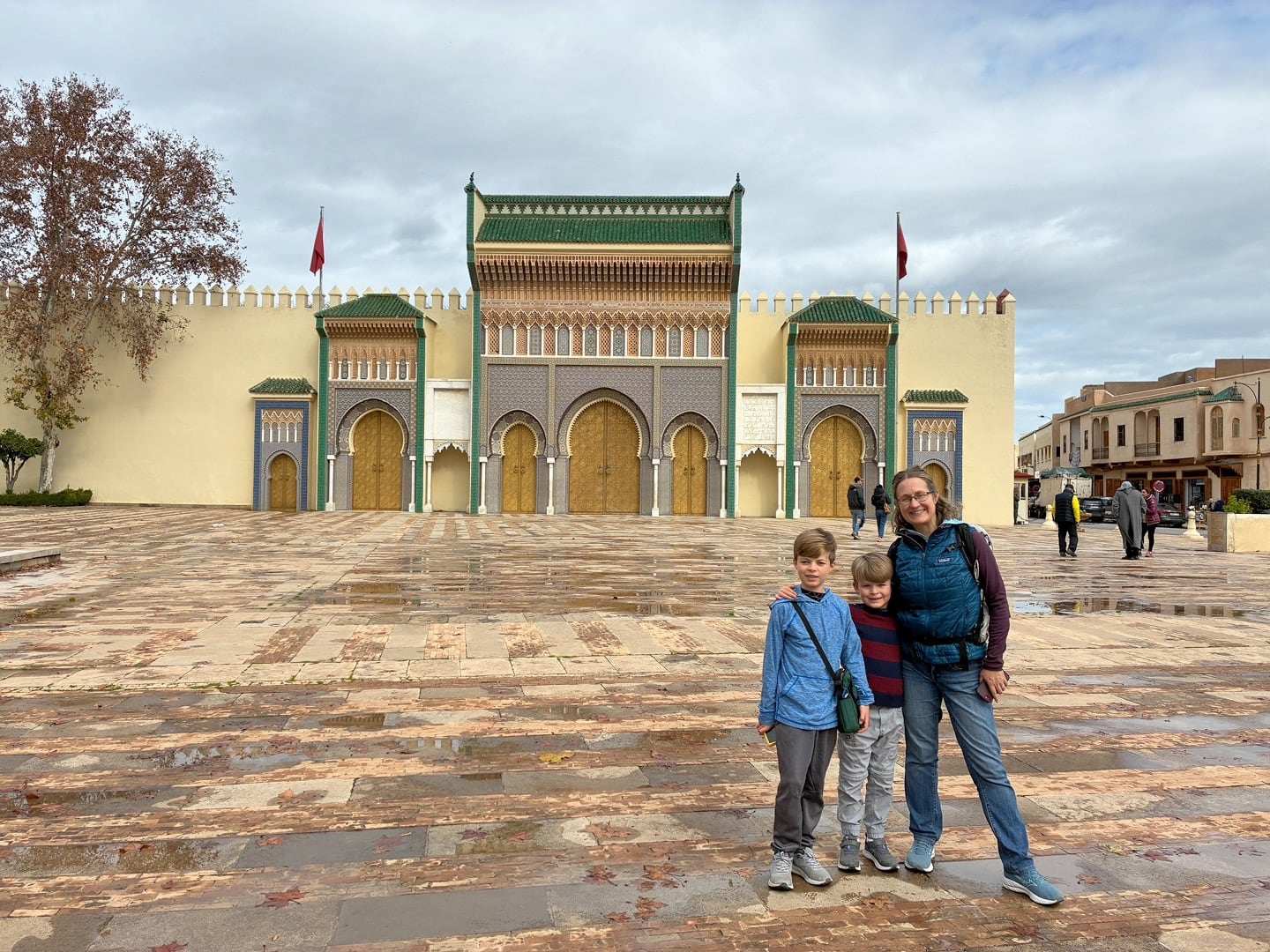
It’s not the King of Morocco’s main residence, but it is his official residence when he’s visiting the city. Dating to the 13th century, public access is strictly prohibited. This is about as close as most commoners get.
Linger more than a couple of minutes (like we did) and the guards will start to sternly wave you away. You’ve been warned.


Returning through Bab Boujloud, the main gate into the Fez Medina.
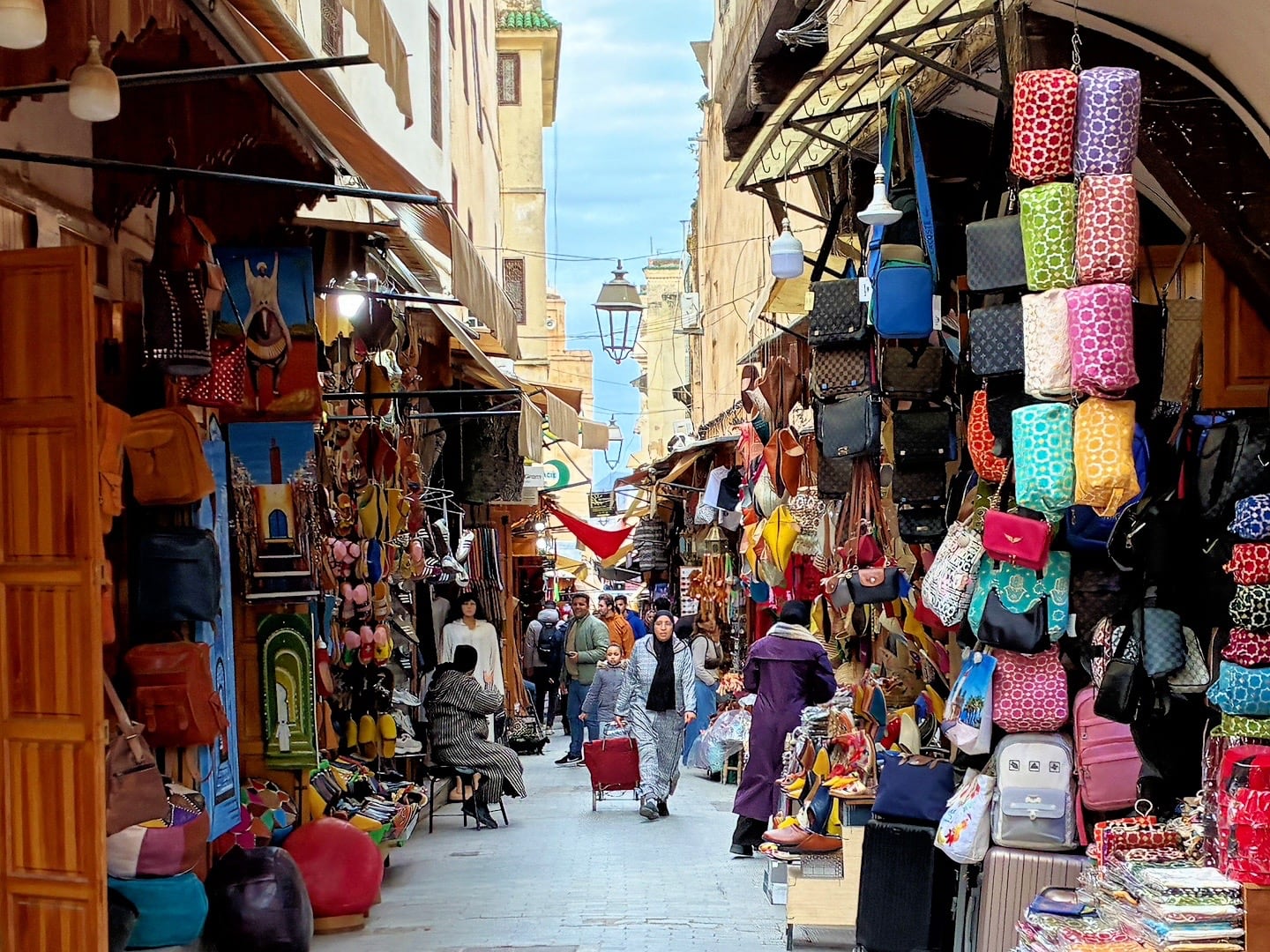


We aren’t generally the shopping type (we have to carry anything we buy on our backs, these days). But in Fez, we made a rare exception.
I really wanted a small, legit genie lamp from here and Noe was hoping to leave with an old coin or two.
We found both at this small shop in Souk al Saffarin.


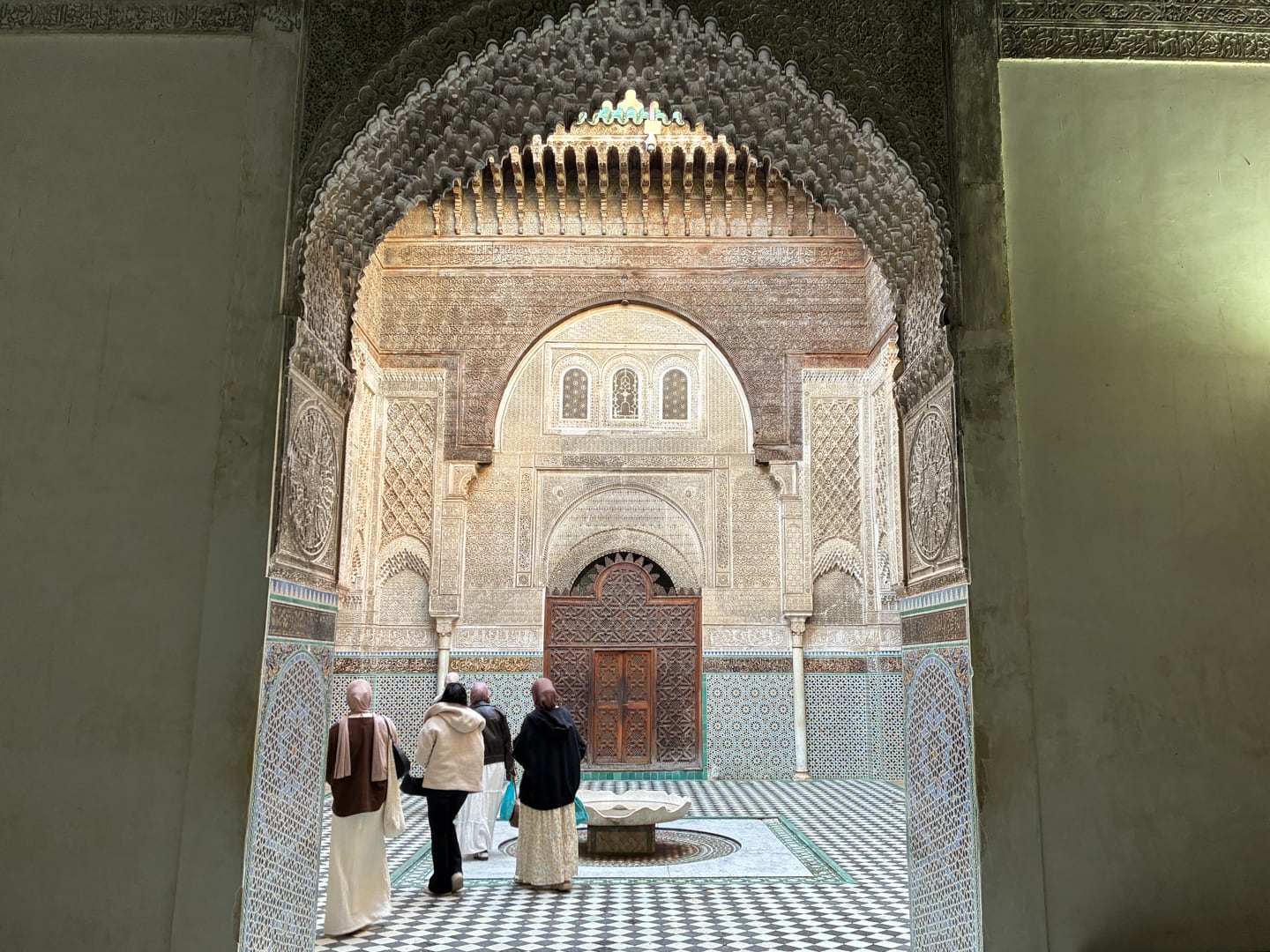
The Medina, itself, is the main attraction here. But there are a few significant historic sights scattered across the Old City. One of our favorites was the Al-Attarine Madrasa, dating to the 14th century.


It’s a kid’s paradise offering lots of mysterious nooks and crannies to explore.


And unique perspectives of Medina life from above.