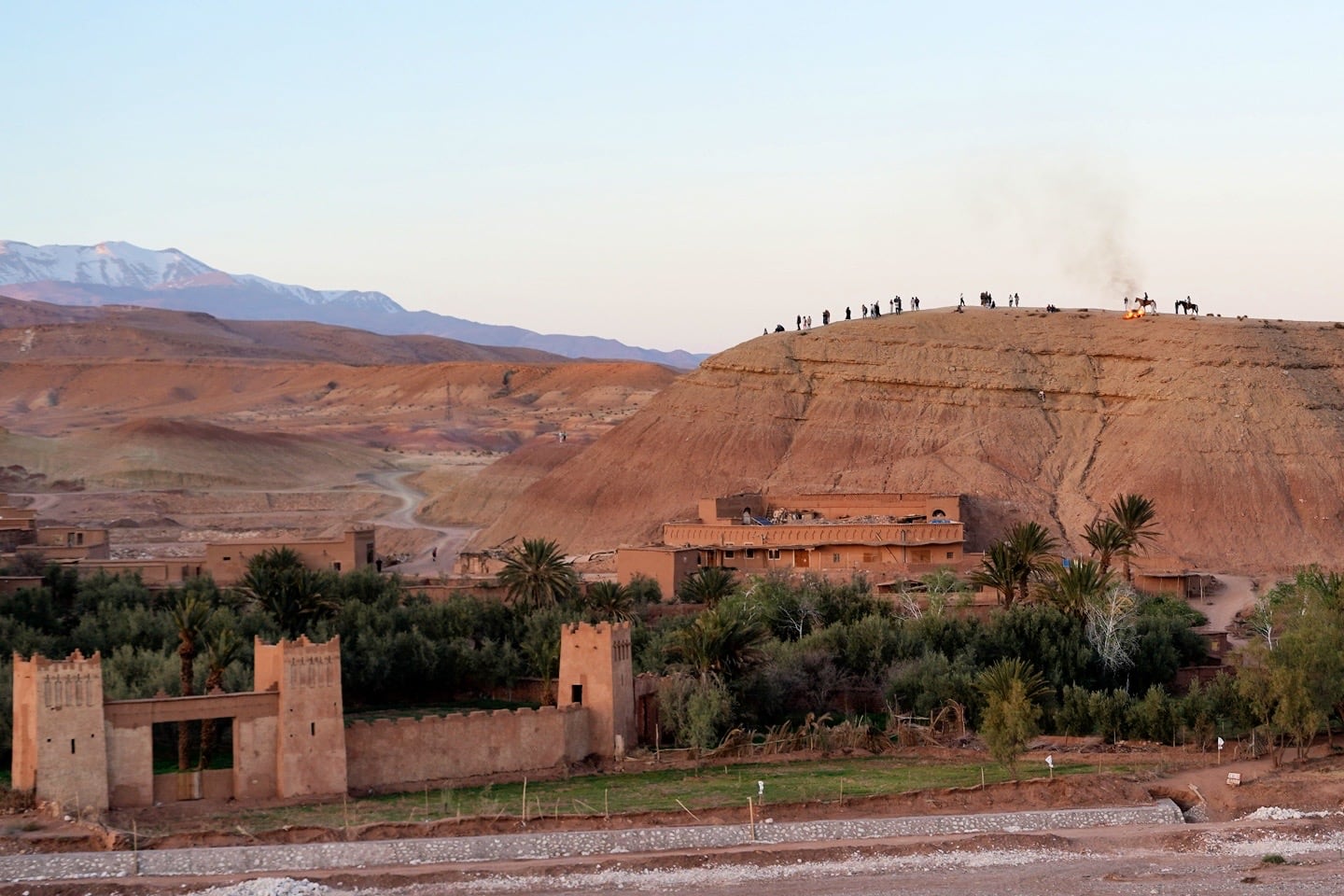
Yesterday, we set off on an 11-day road trip following the ancient trans-Saharan caravan route from Marrakesh to Timbuktu.
The plan is to head over the snow-capped High Atlas Mountains to the Ounila Valley, then make our way through the Tafilalet region (often called the “Route of a Thousand Kasbahs” or the “Oasis Route”) to the red dunes of Erg Chebbi in the Sahara Desert, before finally returning to Marrakesh.
Our Euro-African Journey (So Far...)

Seeing Erg Chebbi has been on my list for many years. But making it to the eastern edge of Morocco (mere miles from Algeria) wasn’t sounding likely this time around.
The more practical option for getting our Sahara fix was to do a much quicker trip to Zagora from Marrakesh. We could get where we needed to get fairly easily via a combination of public buses and taxis, and it wouldn’t take a week to do so.
I considered the idea for several days, but ultimately realized I really didn’t want to go to Zagora. We’ve come all this way and we have the time for a bigger trip. How could we not find some way to make it to Erg Chebbi?
After more failed attempts at piecing together an Erg Chebbi trip using public transport, I began to miss the RV. Too bad we can’t just drive ourselves, I thought. Or could we?
I found that it was not only possible to self-drive, but that it’s widely considered to be an ideal, if often overlooked, road trip. The highways are well-maintained, services are good, and there is quite a bit to see along the way.
Lori didn’t take much convincing. After five months without our own wheels, we were both excited by the idea of hitting the open road again.
By the end of the evening, I had booked an all-wheel-drive Dacia Duster (which turned out to be a very capable Romanian midsize cross-over), and all of our accommodation for the trip.
A quick side note on car rentals in Marrakesh. I was originally planning on going through a major rental car company like Avis or Thrifty, but the reviews for these places were pretty awful. I also wasn’t impressed with the prices and insurance options available.
After getting sucked into the research rabbit-hole, I ended up going with a local company called MarHire.
Their cars are late-model vehicles and they include a comprehensive insurance package in their base rate (in a place like Morocco, you generally don’t want to rely on credit card coverage or U.S.-based primary coverage, alone). They also deliver the car to wherever you need them to in the city.
We ended up having a very positive experience with them, so if you ever find yourself in a similar situation, I’d recommend checking them out.

Waiting with our stuff for the rental car to arrive. A short while later, we were on our way out of Marrakesh, headed directly for the intimidating-looking snow-capped peaks of the High Atlas Mountains.

The Atlas range runs from the Atlantic Ocean to the Sahara in the east, bisecting the entire country. Marrakesh is located just north of the range and the desert is located to the south. The only reasonable way to get between the two is by crossing the mountains at a place called Tizi n’Tichka at 7,400 feet eleven (Marrakesh sits at 1,500 feet).
You can see the mountains on a clear day from nearly anywhere in Marrakesh (including our apartment’s balcony). That meant, I had the entire week to ponder the road conditions up there.
I couldn’t find any reliable resources for checking road conditions, but any concerns I had were eased by the fact that the region hadn’t received any measurable rainfall in a while and the highway we planned to use was a primary route that’s quickly plowed and salted when required.

Along the way, we passed under reader boards warning against chutes de pierres (rockfalls), but nothing about snow or closures. Onward!


Higher and higher we climbed.
It takes only two hours to get from central Marrakesh to the top of the pass. In fact, the road doesn’t even start to climb until you pass the town of Taferiat. Between Taferiat and Tizi n’Tichka, it’s a 6,000-foot climb over 30 just miles.
Thankfully, our zippy Dacia handled the climb with ease. After many similar driving days like this with our 5.5-ton RV in the Mexico highlands, it all felt way too easy. The drive was actually…fun!
A few miles shy of the summit, we found ourselves in a small, dusty transit village. Lori noticed a cafe with a good view listed on the map. We didn’t think it would be functional during Ramadan, but stopped anyway. Sure enough, they were open and happy to serve us some mint tea on the rear terrace.


Riley needed to use the bathroom, but we were all enjoying our tea and the view too much to go with him. He returned a short while later with a puzzled look on his face.
Me: “Did you use the bathroom?”
Riley: “Um…No?”
Me: “Why not?”
Riley: “I couldn’t get to the toilet.”
Me: “You couldn’t find it?”
Riley: “NO! I couldn’t GET TO IT.”
Hmm. Confused, I got up and followed Riley to the back of the cafe and down the stairs. There was a sign with “WC” and an arrow pointing down more stairs, but on the landing, Riley pointed emphatically to this.

Seems they had placed an old toilet under the sink for storage, fooling poor Riley. We continued on to the WC below and he was quite relieved, so to speak. And I’m relieved he didn’t try to actually use the pink toilet.

Back in the car, it was time to make our way to the pass summit.

Clear pavement all the way.

The view from Tizi n’Tichka, the highest drivable point in Morocco at 7,415 feet (2260m) elevation. From here, it was an easy one-hour drive down to 4,200 ft. and the ancient UNESCO-designated red-earth fortified village of Ait Benhaddou.


Rockslides are the biggest hazard on this road. We encountered several places where we had to use a rudimentary detour to go around damaged stretches of the highway.


On the other side of the range!

Under the intensely-blue skies of Morocco’s Ounila Valley, we rolled into the village of Aït Benhaddou and checked into our lodging for the next couple of nights.

La Fibule d’Or is a traditional Moroccan guest house (the oldest in town, we’re told) that started life as a Kasbah (small fort).
Nothing fancy, just the basics. But it’s hard to imagine a better rooftop view in town.